What You’re Actually Paying For When Legal Client Software Costs $700+/Month
The question is whether the customer should be paying for the structure of the vendor, or for the product the vendor sells. DocketBreeze is built on the answer that the customer should be paying for the product.
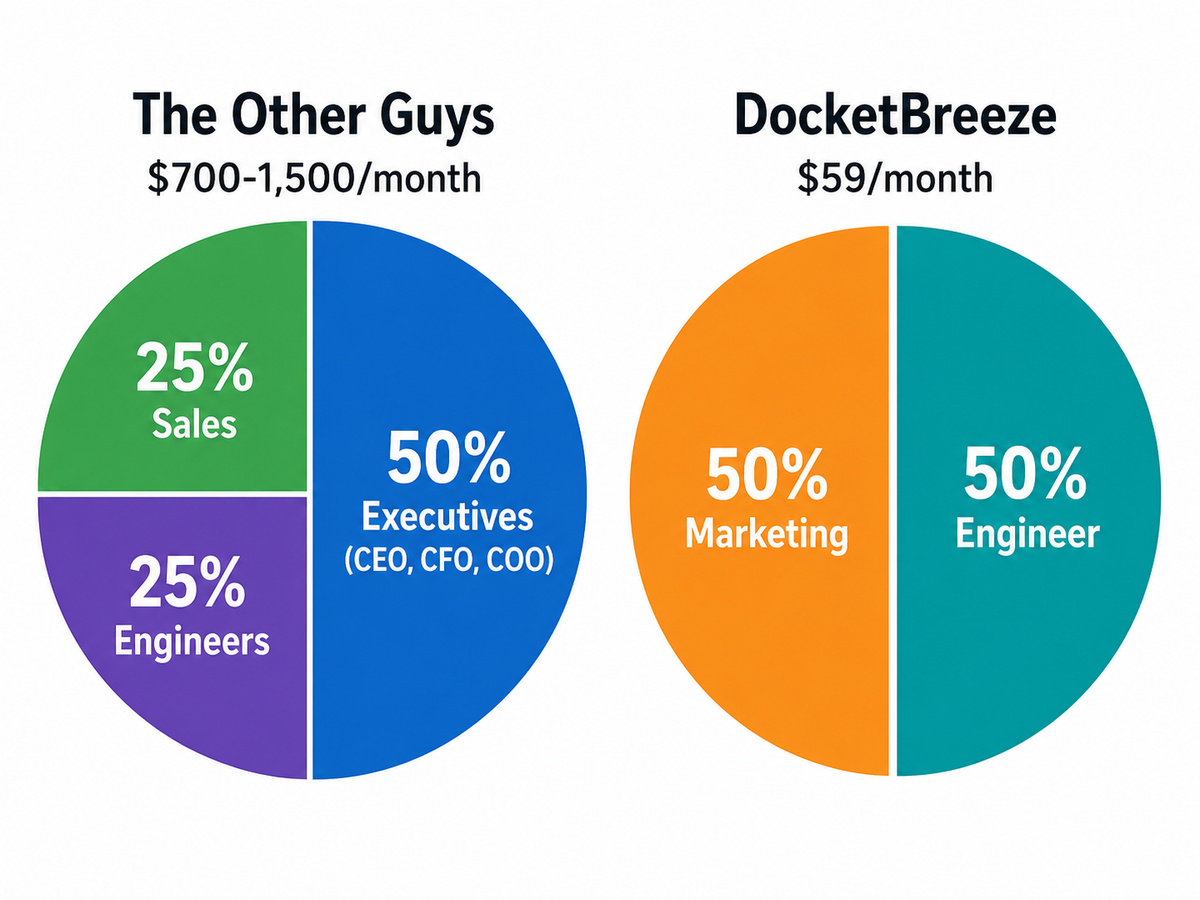
It's worth thinking carefully about what you're actually buying when you sign up for legal client software priced at $600 to $700 (or more) per attorney per month. The product itself; the client portal, the messaging, the case tracker, doesn't cost that much to build or run. So where does the rest of the money go?
This is not a rhetorical question. The breakdown is fairly knowable, and it's useful to see clearly.
Roughly a Third Goes to Sales
Enterprise software sells through a sales motion. That means a sales development representative making outbound calls, an account executive running discovery and demos, a sales engineer answering technical questions, a sales manager forecasting the pipeline, and a commission paid on every closed deal. Each of those roles is well-compensated, and each is allocated some fraction of the revenue from every customer. Across a typical enterprise SaaS company, sales costs eat 25 to 35 percent of revenue.
If your annual contract is $8,000, you've contributed roughly $2,500 to the sales operation that closed your deal. That's true even if you only spoke to a single person.
Another Third Goes to the Org Chart Above the Product
Public legal-tech companies, and the venture-backed ones approaching public scale, run org charts that include a CEO, a CFO, a COO, a CMO, a CTO, multiple VPs, directors, and managers. None of these roles touches the code or talks to the customer directly. All of them are paid well, and their salaries are recovered from subscription revenue. A company with 200 employees of which only 40 are engineers spends most of its payroll on something other than building the product.
If your annual contract is $8,000, another $2,000 to $3,000 of it pays for the layer of the company that exists between the engineers and the lights.
The Remainder Pays for the Product Itself
Engineering, hosting infrastructure, customer support, and reasonable margin. This is the part that makes the product work. It's the smallest slice of the price by a meaningful margin.
DocketBreeze Removes the First Two Slices
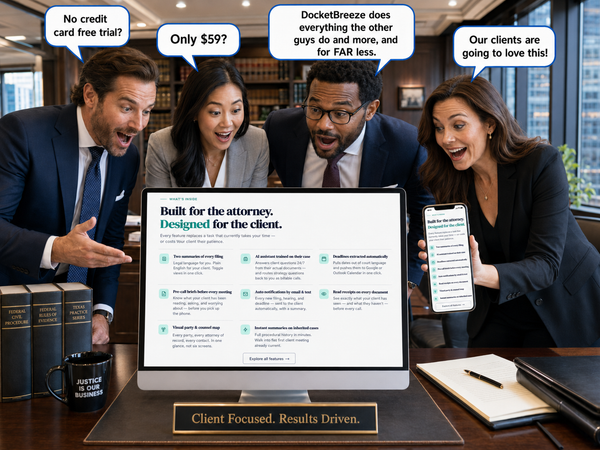
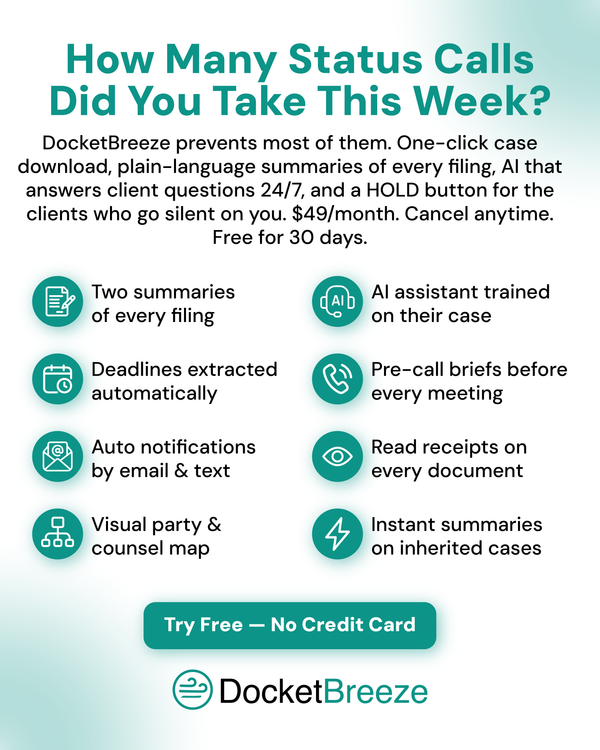
DocketBreeze is a two-person company at launch. There is no sales team. The trial is self-serve; 30 seconds to install, no credit card, no demo required. The price reflects what it actually costs to build, run, and improve the software, plus reasonable margin. The sales overhead and the executive org chart, the two largest cost categories at legacy competitors, don't exist.
$59 per attorney per month, or $49 paid annually. That's the entire price. Every feature included.
The legacy legal-tech companies aren't doing anything wrong by being structured the way they are. Companies grow. Org charts expand. Sales teams get hired. The price reflects what it costs to operate at that scale. The question is whether the customer should be paying for the structure of the vendor, or for the product the vendor sells.
DocketBreeze is built on the answer that the customer should be paying for the product.