Why Most Legal Software Trials Are Designed to Be Hard
Companies that need a hard sales motion are usually companies whose product can't survive an easy one. The reverse is also true. A trial that's frictionless is a quiet way of demonstrating confidence in the product.

Try, this week, to actually evaluate one of the major legal client experience platforms. Not commit. Not buy. Just try.
Here's roughly what happens. You fill out a contact form. A sales development representative emails to schedule a discovery call. The discovery call is 30 minutes. After the discovery call, a sales engineer schedules a demo. The demo is an hour. After the demo, the sales rep follows up with a quote. The quote requires a credit card to start the trial. Starting the trial requires migrating data; your firm's clients, cases, contacts, into the new system before you've decided whether you want it.
By the time you've made it through that process, you've spent five or six hours. You've handed over your data. The annual contract is on the table. Cancelling now feels like a defeat, you've already invested too much.
That feeling is not an accident. It is the design.
The Sunk-Cost Trap, Built In
Enterprise sales motion is calibrated to maximize the cost of saying no. Each step; the discovery call, the demo, the data migration, the credit-card-on-file, increases the customer's psychological investment in continuing. A customer who has invested six hours and given the vendor their data is much more likely to convert than a customer who has invested ten minutes.
This is rational from the vendor's perspective. The math of enterprise sales requires high conversion rates from qualified leads, because each lead costs hundreds of dollars to source. Friction in the trial process is, perversely, the thing that makes the economics work.
It is, however, deeply hostile to the customer's actual interest. Which is to find out, as cheaply and quickly as possible, whether the product is worth using.
DocketBreeze Inverts the Whole Thing
DocketBreeze's trial requires a name and an email. No credit card. No sales call. The Chrome extension installs in 30 seconds.
You drag and drop the documents from one or two existing cases; a discovery motion, a court order, or even a zip file with the entire case, whatever you have on hand, and the platform begins working within minutes.
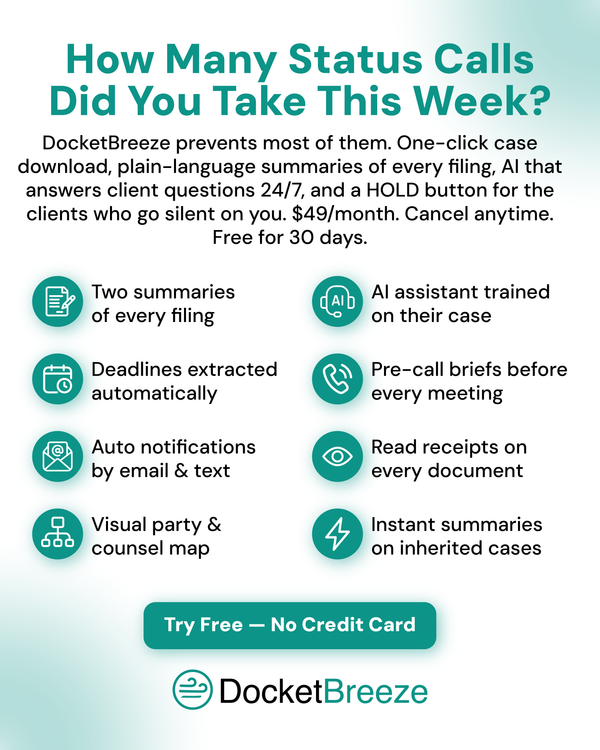
- Plain-language summaries appear.
- The color coded timeline populates.
- Deadlines extract.
- Names of opposing counsel and others associated with the case and their contact information.
- Other letters and files are read and placed in their own section.
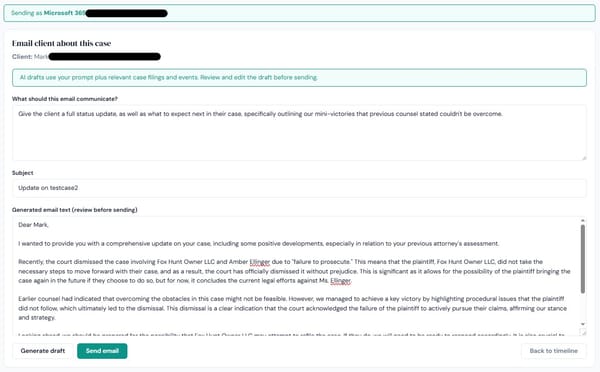
- The DocketBreeze AI assistant immediately becomes ready to answer questions about those specific cases.
What used to take several hours to put everything in order, takes just a few minutes. Add in your client's name and email and they get sent an invitation to immediately access to their entire case along with the ability to ask any question about it. In five minutes time both you and your client have access to their matter.
Thirty days. No commitment. If you decide it's not for you, the trial ends and there's nothing to cancel because nothing was ever charged.
The Real Reason This Matters
The point isn't just that DocketBreeze's trial is more pleasant. It's that the structure of the trial reflects the structure of the company. A self-serve trial is only viable if the product is good enough to sell itself, because there's no salesperson to push, no migration consultant to keep the customer engaged, no credit card already on file to discourage cancellation.
Companies that need a hard sales motion are usually companies whose product can't survive an easy one. The reverse is also true. A trial that's frictionless is a quiet way of demonstrating confidence in the product.
If the product doesn't do what it claims, you'll know in a week. Cancel and move on. Nothing was lost; not money, not data, not time spent in sales calls. That's how a software trial should work.