White-Labeling: Why Your Software Should Wear Your Brand, Not Someone Else’s
DocketBreeze defaults to the firm's brand on every surface the client sees, and stays out of the way.
There's a subtle thing that happens when a law firm uses unbranded software with its clients. The client receives a notification. They open it. The interface is clearly third-party; a logo they don't recognize, a domain they've never heard of, a layout that's clearly not the firm's own.
The client doesn't articulate it consciously. But the impression has been made: this lawyer is using somebody else's tool to talk to me. The relationship feels slightly less direct. The brand of the firm sits next to, rather than around, every interaction.
This matters more for a solo practitioner or small firm than for almost any larger size of practice. Big firms have brand presence in every direction — the office, the letterhead, the website, the firm name on the building. Solo and small firms have to build brand presence in every interaction, because every interaction is one of the few they have.
Where White-Labeling Actually Matters
The honest observation about white-labeling is that it matters where the client sees it. Whether the attorney's internal dashboard carries the software vendor's logo is largely irrelevant; the client never sees that screen. What matters is the side the client touches: the portal where they read their case updates, the notifications that arrive in their inbox, the mobile experience they use to ask questions.
That client-facing surface is where branding either reinforces the firm or dilutes it. And that's exactly where DocketBreeze applies it.
What DocketBreeze White-Labels
The client portal carries the firm's logo, the firm's name, and the firm's color palette throughout. When the client logs in to read a plain-language summary or check a deadline, they're inside an experience that visually belongs to the firm, not to a software vendor they've never heard of.
Notifications come from the firm's own email domain, with the firm's signature block. When the client receives a case update, the message looks and reads like correspondence from the firm, because that's what it is.
The mobile experience uses the same branding. The client adds DocketBreeze to their phone and sees the firm, not the platform.
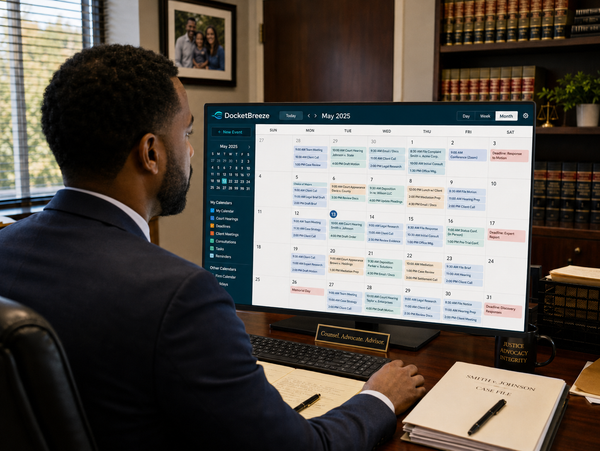
The attorney portal, the side only the lawyer and paralegal see, carries the DocketBreeze brand. That's deliberate. Internal tools should be efficient and recognizable to the people who use them every day. The lawyer's identity isn't built in the dashboard they log into; it's built in every interaction the client has.
The Email Detail Most Firms Miss
Most client experience platforms send notifications from a third-party domain, something like notifications@vendorname.com. That choice has two effects, one obvious and one less so.
The obvious one is brand dilution. Forty messages over the course of a case, each carrying the vendor's domain rather than the firm's, is forty small reminders that the firm isn't the one running the conversation.
The less obvious effect is on deliverability. Email from a bulk-sending vendor domain is more likely to land in spam folders or promotions tabs than email from a firm's own domain. Even when it lands in the inbox, the client's eye learns to pattern-match the sender as automated software, not as the firm.
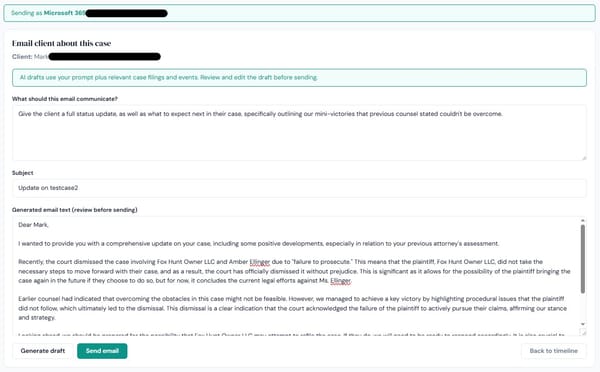
DocketBreeze handles this differently. Notifications can be sent from the firm's own corporate inbox; Google Workspace, Microsoft 365, whichever one the firm already uses. Every message comes from the firm's actual email domain. The firm's sent folder shows the message there too, useful for the lawyer's own records and for client trust.
Why This Compounds Over Time
The cumulative effect of consistent client-facing branding is hard to measure but real. A client who has dozens of touchpoints with a firm, each of them carrying the firm's name and visual identity, ends a case with the firm's brand firmly established. A client who has the same number of touchpoints with a third-party platform that handles the firm's communication ends the case knowing the firm and also knowing the third party. The latter is a small dilution of attention.
Six months later, when the client's friend mentions a legal problem, what comes to mind is what was reinforced during the case. If every notification, every portal login, and every document delivery carried the firm's brand, the firm is what comes to mind. If a third-party platform was visible alongside the firm at every touchpoint, the platform shares the memory.
The Whole Game
Most lawyers know branding consistency matters with clients. The reason it doesn't always happen is that maintaining it across every channel takes work, and most software makes the work invisible enough to skip. DocketBreeze defaults to the firm's brand on every surface the client sees, and stays out of the way.
Clients see the firm. The firm builds equity in its own name. That's the whole game.