The $20,000 Question: Why Solo Firms Pay Enterprise Prices for Client Software
The technology a solo firm needs is not, in any meaningful sense, different from what a 50-attorney firm needs. The same client portal. The same automated updates. The same branded experience. So why does the solo firm pay something close to enterprise prices?

Get a quote from one of the major legal client-experience platforms as a solo practitioner and you'll usually land somewhere between $18,000 and $24,000 a year. The exact number takes a sales call to extract. The number itself, once finally spoken, sits oddly against the size of your practice.
It's worth asking why this happens. The technology a solo firm needs is not, in any meaningful sense, different from what a 50-attorney firm needs. The same client portal. The same automated updates. The same branded experience. So why does the solo firm pay something close to enterprise prices?
The Sales Model Drives the Price
Both major legacy platforms in this space sell through enterprise sales motions. That means a sales rep, a discovery call, a custom demo, a proposal, a negotiation, an implementation manager, an onboarding consultant. Every step costs money. The cost is the same whether the customer is a 50-attorney firm or a one-attorney firm. So the price has to support it either way.
This is not a criticism of the people doing the selling. It's an observation about the structure. A company built on enterprise sales cannot economically serve a solo practitioner at $50 a month, because the cost of acquiring the customer exceeds the revenue.
The Org Chart Drives the Price Too
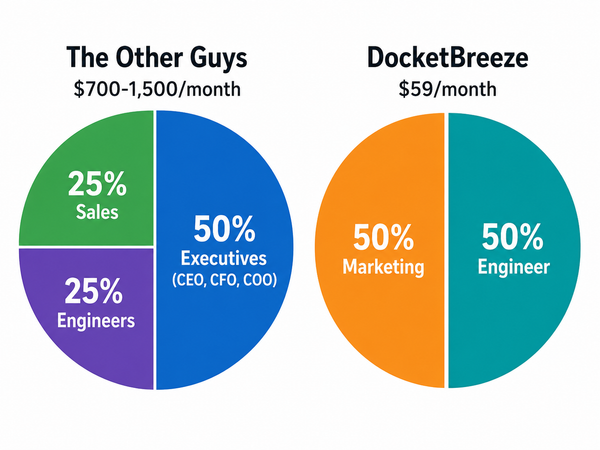
Both companies have grown into organizations with dozens of high-paid executives, full marketing departments, sales teams paid on commission, and customer success teams sized to retain enterprise contracts. Every salary in those organizations is baked into the price the customer pays. A solo practitioner who subscribes is, in effect, helping pay the VP of Customer Success at a company they'll never meet.
Again, not a criticism. Companies grow. Org charts expand. The price reflects what it costs to keep the lights on at that scale.
DocketBreeze Costs Less Because It's Built Differently
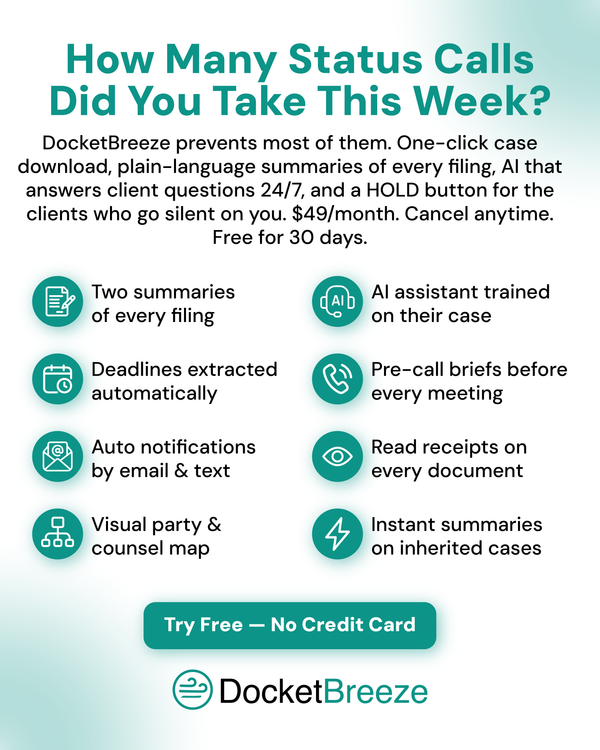
DocketBreeze is a two-person company at launch. There is no sales team. There is no VP of anything. The trial is self-serve; 30 seconds to install, no credit card, no demo required. The price is published openly on the website: $59 per attorney per month month-to-month, $49 if paid annually.
The product is structurally cheaper to deliver because it's built and run by people who decided not to scale into the org chart that requires enterprise pricing. Every dollar of the subscription goes into the product, not the sales motion that closes the contract.
The math, for a solo practitioner, lands somewhere around $600 a year on the annual plan. That's a different conversation from $20,000.
There's no good reason a solo firm should pay enterprise prices for software the solo firm is the one using. The price should reflect the customer. DocketBreeze prices the product for the customer it was built for.